About Fadi Murad
Fadi Murad (born 1999, Jerusalem) is a Palestinian multidisciplinary performance artist exploring loss, identity and cultural memory. His practice blends text, movement, sound and visual composition across theatre, sound and installation.
The loss of his mother in a 2009 car accident has shaped his perspective as an artist. After a year studying psychology in Madrid, he turned to art and graduated from the School of Visual Theatre in Jerusalem in 2023 with Come Back Home.
He has presented work at Les Urbaines in Lausanne and at the Edinburgh Festival Fringe, designed sound for Shaden Dance Company’s Feathers, and performed in Guernica, Gaza with Ashtar Theatre. In 2025 he premiered A Call from Afar under the Sawa Sawa residency at Al-Hakawati Theatre, and made two sound-based music videos with Mishkal during a residency at the Goethe Institute in Ramallah.
In August 2026 Come Back Home ran for the whole Edinburgh Festival Fringe at Summerhall, supported by the Meadows Award. He is based in East Jerusalem.
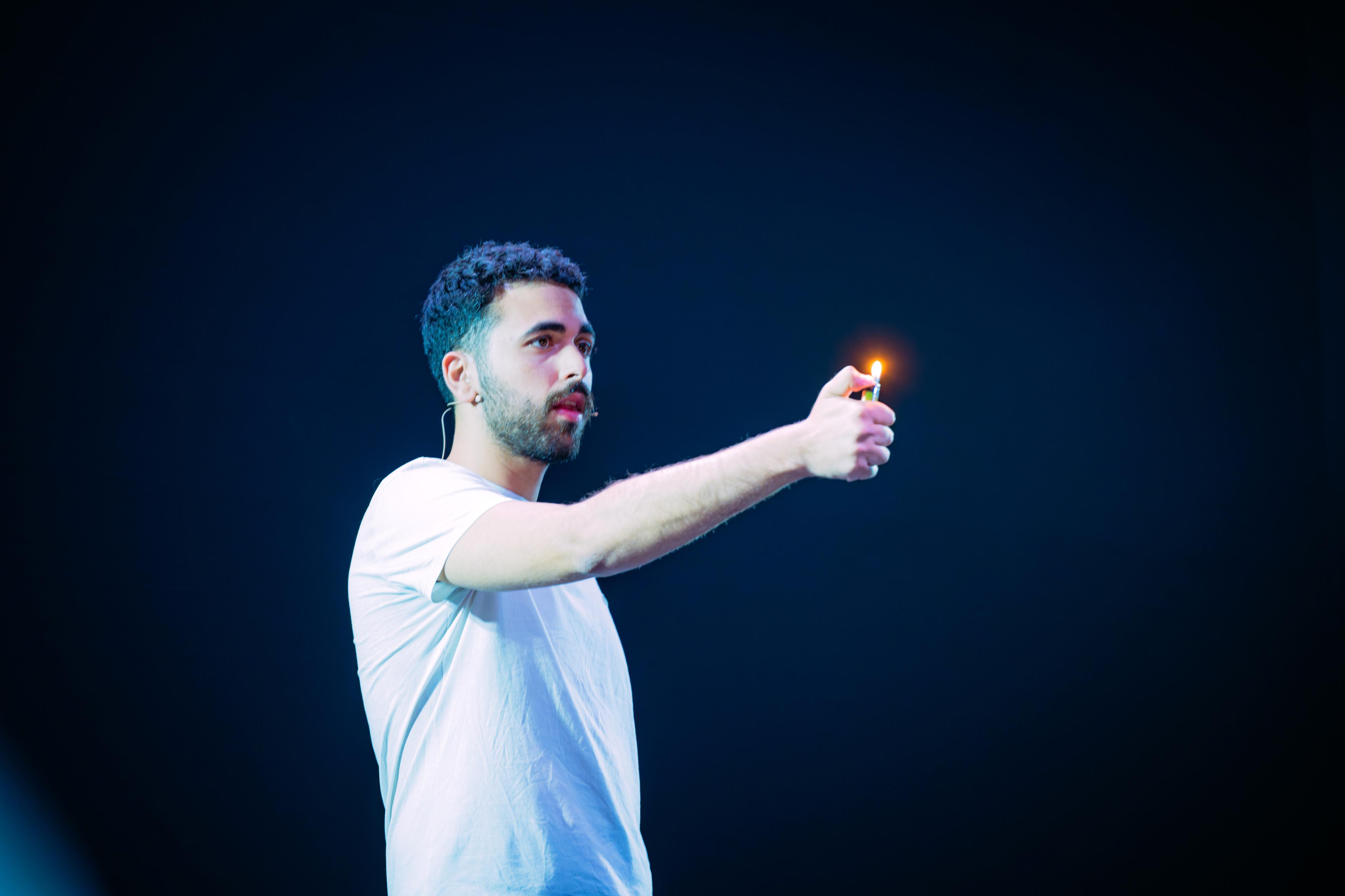
In his words
My work investigates fear, restriction, and displacement as conditions that shape both the self and the stage. I explore how forces of oppression, bureaucracy, and cultural erasure affect the artist's body and voice, asking what it means to be unheard, immobilized, or cast as the villain. Through writing, sound, and staged imagery, I examine how media and social narratives construct hidden truths, and how performance can expose them. For me, the stage is not a place of answers but of materializing questions—transforming lived limitations into resonant, sensorial experiences.
“Fadi Murad's performance-based practice melds several mediums: text, video, sound works, reenactment, and use of archival material. Humor is as present as mourning and death, whether in the evocation of the loss of his mother or moving between East and West Jerusalem, as sublimated by words and the vertigo of repetition. Searching for loopholes in everyday life under occupation, Fadi Murad lays bare, through poetry, the hypocrisy of authoritarian systems.”
Themes
- Memory & loss
- archival material, reenactment, and personal narrative.
- Place & belonging
- East/West Jerusalem, movement, and identity.
- Humor & mourning
- juxtaposition of the comic and the elegiac.